
Make the016.com a preferred choice with Google by clicking here 

If the House of Representatives selects the president, each state would get a single vote – not one vote per House member. iStock / Getty Images Plus
Donald Brand, College of the Holy Cross
If the the 2020 U.S. presidential election is contested, both campaigns are preparing to take the matter to court. But the Founding Fathers meant for Congress to be the backup plan if the Electoral College did not produce a winner.
Generally, the framers sought to avoid congressional involvement in presidential elections. They wanted an independent executive who could resist ill-considered legislation and would not care about currying favor with members of Congress, as James Ceaser explained in his definitive 1980 text, “Presidential Selection.”
That’s why they created the Electoral College, assigning to state legislatures the responsibility for choosing “electors” who then determine the president.
But the framers could foresee circumstances – namely, a fragmented race between little-known politicians – where no presidential candidate would secure an Electoral College majority. Reluctantly, they assigned the House of Representatives to step in if that happened – presumably because as the institution closest to the people, it could bestow some democratic legitimacy on a “contingent election.”
The founders proved prescient: The elections of 1800 and 1824 did not produce winners in the Electoral College and were decided by the House. Thomas Jefferson was chosen in 1800 and John Quincy Adams in 1824.
Over time, the development of a two-party system with national nominating conventions – which allows parties to broker coalitions and unite behind a single presidential candidate – has basically ensured that the Electoral College produces a winner. Though the Electoral College has changed significantly since the 18th century, it has mostly kept Congress out of presidential selection.
As a professor who has taught courses on presidential elections for two decades, however, I can see scenarios in which Congress gets involved in the 2020 election.
A tie in the Electoral College remains a possibility, however remote. There are 538 electors, so a minimum majority to win is 270. The website 270toWin lists 64 hypothetical scenarios in which both Joe Biden and Donald Trump could get 269 electors. That would throw the election to the House.
Though the House has a Democratic majority, such an outcome would almost certainly benefit Trump.
Here’s why: In a concession to small states concerned their voices would be marginalized if the House was called upon to choose the president, the founders gave only one vote to each state. House delegations from each state meet to decide how to cast their single vote.
That voting procedure gives equal representation to California – population 40 million – and Wyoming, population 600,000.
Currently, this arrangement favors the Republicans. The GOP dominates the delegations from 26 states – exactly the number required to reach a majority under the rules of House presidential selection. But it’s not the current House that would decide a contested 2020 election. It is the newly elected House that would choose the president. So the outcome depends on congressional races.
One more caveat: Split decisions are considered abstentions, so states that cannot reach an agreement would be counted out.
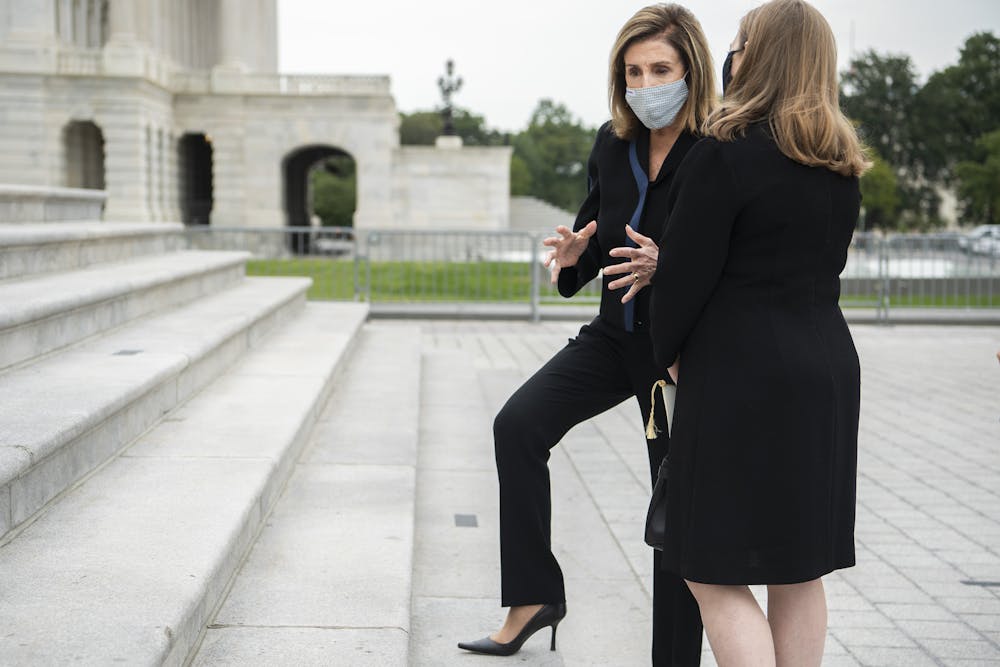
House Majority Leader Nancy Pelosi is reportedly preparing for the possibility that presidential selection ends up in the House. Tom Williams/CQ-Roll Call, Inc via Getty Images
Another way Congress could become involved in the 2020 election is if there are disputes about the vote totals in various states. Given the spike in mail-in voting during the pandemic, threats of foreign interference and controversies over voter suppression, uncertainty after Nov. 3 seems likely.
Perhaps the most relevant precedent for that scenario is the 1876 election between Democrat Samuel Tilden and Republican Rutherford B. Hayes. That election saw disputed returns in four states – Florida, South Carolina, Louisiana and Oregon – with a total of 20 electoral votes.
Excluding those 20 disputed electors, Tilden had 184 pledged electors of the 185 needed for victory in the Electoral College; Hayes had 165. Tilden was clearly the front-runner – but Hayes would win if all the contested votes went for him.
Because of a post-Civil War rule allowing Congress – read, Northern Republicans worried about Black voter suppression – to dispute the vote count in Southern states and bypass local courts, Congress established a commission to resolve the disputed 1876 returns.
As Michael Holt writes in his examination of the 1876 election, the 15-member commission had five House representatives, five senators and five Supreme Court justices. Fourteen of the commissioners had identifiable partisan leanings: seven Democrats and seven Republicans. The 15th member was a justice known for his impartiality.
Hope of a nonpartisan outcome was dashed when the one impartial commissioner resigned and was replaced by a Republican judge. The commission voted along party lines to give all 20 disputed electors to Hayes.
To prevent the Democratic-dominated Senate from derailing Hayes’ single-vote triumph over Tilden by refusing to confirm its decision, Republicans were forced to make a deal: Abandon Reconstruction, their policy of Black political and economic inclusion in the post-Civil War South. This paved the way for Jim Crow segregation.
The 2000 election offers the only modern precedent for contested vote returns.
George W. Bush and Al Gore argued for a month over Bush’s slim, 327-vote advantage in Florida’s second machine recount. After a lawsuit in state courts, this political and legal battle was decided by the Supreme Court in December 2000, in Bush v. Gore.

The scene outside the Supreme Court, Dec. 11, 2000. Shawn Thew/AFP via Getty Images
But Bush v. Gore was never intended to set a precedent. In it, the justices explicitly stated “our consideration is limited to the present circumstances.” Indeed, the court could have concluded that the issues presented were political, not legal, and declined to hear the case.
[Deep knowledge, daily. Sign up for The Conversation’s newsletter.]
In that case, the House would have decided the 2000 election. The Electoral College must cast its ballots on the first Monday after the second Wednesday in December – this year, Dec. 14. If disputed state vote totals are not resolved by six days prior to that date, Congress can step in, under the 1887 Electoral Account Act. This could have happened in 2000, and it is an imaginable outcome in 2020.
The best bet for American democracy, history shows, is a clear and decisive victory in the Electoral College, as the framers intended.
This story was updated on Nov. 5, 2020. The latest version can be found here.
Donald Brand, Professor, College of the Holy Cross
This article is republished from The Conversation under a Creative Commons license. Read the original article.
In The News
>WEATHER: Mark Rosenthal's 7-day forecast (:34). High of 70 today in Worcester
-Mass. could see warmer, wetter winter, National Weather Service says
>TOP OF THE NEWS
+Noon: How Worcester residents can sign up for 2027 health plans
+Noon: Gov. Healey sets 60% school breakfast goal; Worcester schools averaged 37.6%
+Noon: Early voting update: Nearly 10,000 ballots cast so far in Worcester
+Noon: Worcester man's Halloween display raises money for charity (2:57)
-Asbestos discovery closes Worcester Head Start facility
-Kelley Square and Mill Street were redesigned. Are they safer today?
-Worcester Human Rights Commission to review police policies, homeless encampment proposal
-Where is Aaron Pennington? Fugitive search enters third year (2:22)
-Max German of Shrewsbury a finalist in "Voice of Logan" contest
-Westborough police chief on leave following an incident in Shrewsbury (:20). Article
-Parents recall Uxbridge Officer LaPorta as community honors him
-Earlier: D.A.: Investigation into death of Uxbridge officer results in no charges
-Worcester County Wonders: The Phantom of the Palladium
-In historic company: Women of Worcester's past, present honored in new mural
-College closures derail students’ plans, leaving some unsure when they’ll return
>DINING OUT: Avvio Ristorante wins early buzz with home-made pasta and tasty pizzas
-Large audience, low price: Give your restaurant's social media a boost on The 016
-Phantom Gourmet visits Worcester restaurant (5:02)
-ICYMI: Anna Maria weighs giving interested buyers more time after auction cancellation
-Worcester Homeowner Summit set for November 7th at DCU Center
-Worcester police, D.E.A. find fentanyl in Clover Street raid
-Worcester police seize 38 guns, ghost gun frames
-See the rest of the day's Worcester news
>HOLDEN: This week's road closures and traffic delays
-Wachusett Teacher Spotlight: Brian Lux
>THE BURBS (brought to you by North End Motor Sales): Community Advocate Hometown Helper: Bernice Gero, animal advocate
-Warrant issued for man who broke into ex-girlfriend’s home in Barre while she was asleep
-Coolidge Elementary School's hidden staircase evokes Shrewsbury memories from decades past
-Meadows Montessori excited to open in Westborough
-New warehouse plans before Westborough Planning Board
-New Northborough fire chief says he has felt "truly welcomed" by town officials, community
>BARS & BANDS: The Mayor's Live Music List for Monday
>SHOWTIME: Gateway Players in Southbridge to hold auditions for "The Lifespan of a Fact"
-Dudley's first poetry slam brings community to the Fun Zone Playground wooded stage
-100 FM The Pike (20:41): Ken Casey from Dropkick Murphys on music as a force for change
>OPINION: Tommy Dorfman: Ticket prices are out of control. Gov. Healey’s bill will make them worse
-WCCA-TV's Chandler Chat No. 510 (28:21): City clerks & state election
-Radio Worcester's The Rundown reacts to W.P.D. internal investigation in Toomey case (24:59)
>OBITUARIES: Tribute to Worcester native who was a lauded poet
>SPORTS: NESN and NESN+ to broadcast select Holy Cross contests
-Railers lose to Maine, 3-1
-Radio Worcester (15:13): Worcester Railers celebrate 1,000 wins for city hockey
>NATIONAL: Christa Pike's executioners given ominous warning before botched lethal injection: court docs
-Devastated mom recalls horror of toddler being pronounced dead, before he's discovered alive in morgue
-Tragic: Nurse dies after shrimp allergy during honeymoon
>NEW ENGLAND: Sandra Birchmore's therapist back on the stand Monday (:59)
-Woman charged with manslaughter in 4-year-old daughter's fentanyl death (:22)
-Over 130 residents evacuated from Lexington nursing home (2:25)
>POLITICS: What does the Governor's Council do? Worcester candidates weigh in
-What is Mass. ballot Question 7? (8:52)
-Full debate on Mass. ballot Question 7 (29:03)
>COLLEGES: Clark campus conversation, McGovern visit examine America’s past and present
>TRAVEL (brought to you by Fuller RV & Rental): Airbnb making changes to guest cleaning requirements (1:39)
>BUSINESS: Central Mass. business by the numbers
-U.S credit card debt is on the rise. Here's how to keep yourself out of credit card debt
-Small businesses need to leverage home field advantage with S.E.O.
>SHOPPING: How inflation is hitting all parts of Halloween celebration (1:59)
>HOMES: The surprising places to never charge your phone, safety experts say
>HEALTH: "Circadian" depression may be the reason why you can't sleep
-How walking regularly can protect your brain for years to come (6:18)
>FOOD: Ina Garten reveals unique ingredient she uses in eggs
>TV/STREAMING: Trailer for "Lupin: Part 4" on Netflix (2:30)
>MOVIES: The craziest horror villains compilation (42:09)
>CELEBRITY: "Office Space" star Richard Riehle dies at 78
-Kurt Cobain's death investigation takes new turn over cop's shocking claim casting doubt on suicide
>ANIMALS: Hound gets caught breaking all her friends out of daycare (1:54)
>HISTORY: The Old Yarmouth Inn on the Cape is still going strong after 330 years
>GOOD NEWS: Veteran sees brother face-to-face for first time in 40 years
-Meanwhile, in England, escaped emu wins wrestling match in middle of road
Latest obituaries | | Sunday's Highlights | | Today's horoscope | | Local Sports
Classifieds
>HELP WANTED
+Servers, West Boylston restaurant
-Prep cook and waitstaff, Shrewsbury Street bistro
-Full-time police officer, West Boylston Police Department
-Bartenders, Worcester Restaurant Group
See all Help Wanteds | | Job opening? Post it here for FREE today
Quick Links: Personalize your news | | Browse members | | Advertise | | Blogs | | Invite friends | | Videos
Animals | | Boston Sports | | Business | | Cars | | Celebrity | | Colleges | | Commute & Travel | | Crime | | Faith | | Food | | Good News | | Health | | Help Wanted | History | | Homes | | Local Sports | | Lottery | | Movies | | National | | New England | | Politics | | Shopping & Deals | | SHOWTIME! | | TV & Streaming | | Weather

