
Make the016.com a preferred choice with Google by clicking here 
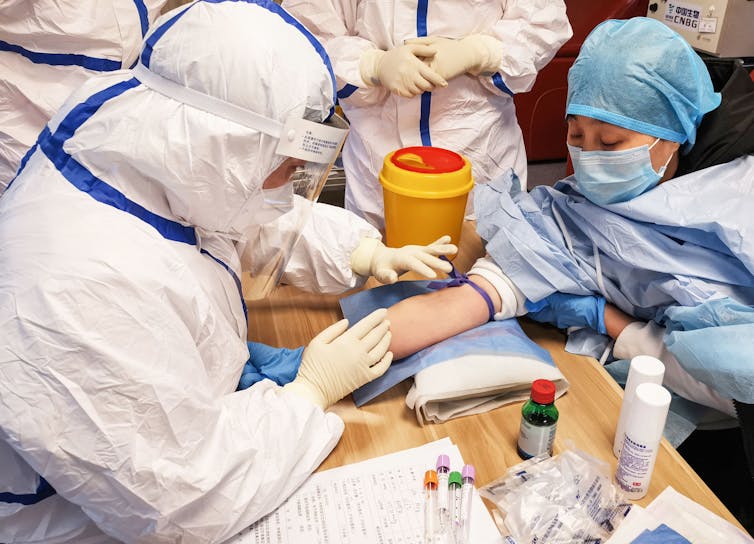 A person who has recovered from COVID-19 donates plasma in Shandong, China. STR/AFP via Getty Images
Ann Sheehy, College of the Holy Cross
Amid the chaos of an epidemic, those who survive a disease like COVID-19 carry within their bodies the secrets of an effective immune response. Virologists like me look to survivors for molecular clues that can provide a blueprint for the design of future treatments or even a vaccine.
Researchers are launching trials now that involve the transfusion of blood components from people who have recovered from COVID-19 to those who are sick or at high risk. Called “convalescent-plasma therapy,” this technique can work even without doctors knowing exactly what component of the blood may be beneficial.
For the pioneering work of the first treatment using therapeutic serum in 1891 (against diphtheria), Emil von Behring later earned the Nobel Prize in medicine. Anecdotal reporting of the therapy dates back as far as the devastating 1918-19 influenza pandemic, although scientists lack definitive evidence of its benefits during that global health crisis.
The extraordinary power of this passive immunization has traditionally been challenging to harness, primarily due to the difficulty of obtaining significant amounts of plasma from survivors. Due to scarce quantities, infusions of plasma pooled from volunteers were reserved for those most vulnerable to infection.
Fast forward to the 21st century, and the passive immunization picture changes considerably, thanks to steady advances in molecular medicine and new technologies that allow scientists to quickly characterize and scale up the production of the protective molecules.
The immune systems of COVID-19 survivors figured out how to combat and defeat the invading SARS-CoV-2 virus.
Neutralizing antibodies are one kind of immunological front-line response. These antibodies are proteins that are secreted by immune cells called B lymphocytes when they encounter an invader, such as a virus.
Antibodies recognize and bind proteins on the surface of virus particles. For each infection, the immune system designs antibodies that are highly specific for the particular invading pathogen.
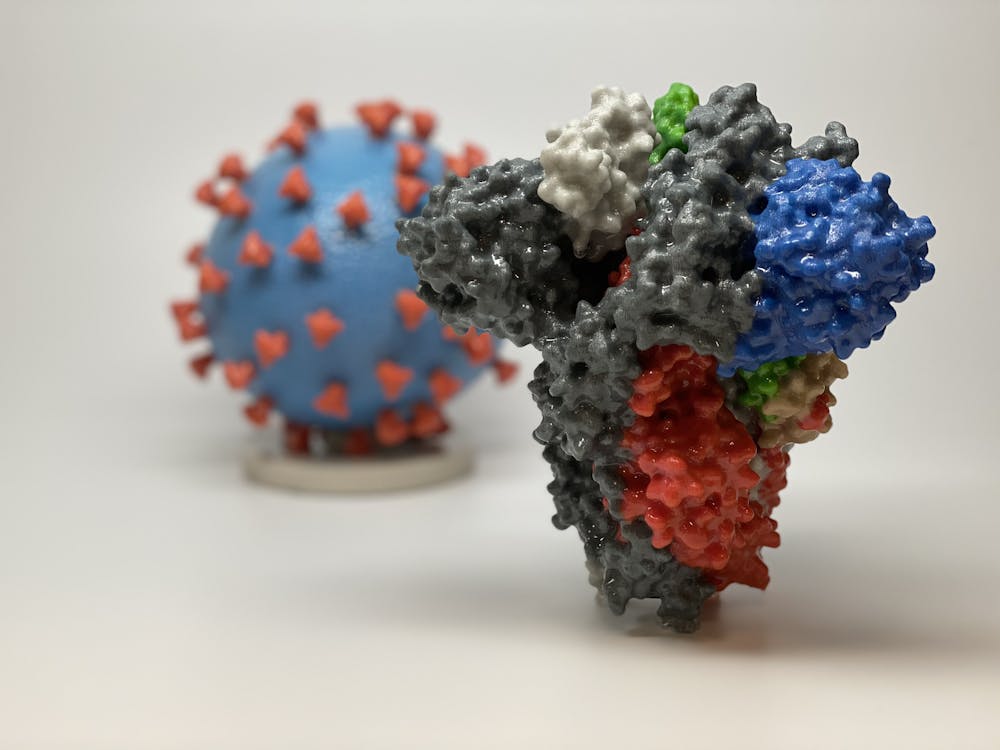 An enlarged 3D model of a single spike protein in the foreground; in the rear is a model of a SARS-CoV-2 virus covered with many of these spike proteins. NIH, CC BY
For instance, each SARS-CoV-2 virus is covered by distinctive spike proteins that it uses like keys to unlock the doors to the cells it infects. By targeting these spikes – imagine covering the grooves of a key with tape – antibodies can make it nearly impossible for the virus to break in to human cells. Scientists call these kind of antibodies “NAbs” because they neutralize the virus before it can gain entry.
A holy grail for vaccinologists is figuring out how to spark the production of these ingenious antibodies. On first infection, your B lymphocytes train themselves to become expert producers of NAbs; they develop a memory of what a particular invader looks like. If the same invader is ever detected again at any time, your veteran B lymphocytes (known as memory B cells by this stage) spring into action. They rapidly secrete large quantities of the potent NAbs, preventing a second illness.
Vaccines capitalize on this ability, safely provoking an immune response and then relying on the immune system’s memory to be able to fend off the real pathogen if you ever encounter it.
Passive immunization is a process in which neutralizing antibodies from one individual can be used to protect or treat another. A clever example of this process exploited by nature is breastmilk, which passes protective antibodies from the mother to the infant.
In addition to their potential preventative role, neutralizing antibodies are starting to prove beneficial in novel treatments for viral disease. Harnessing their protective power has been challenging, though, primarily because isolating enough antibodies to be effective is laborious.
Recent advances in the technology of molecular medicine at last allowed the kind of scale-up that enabled researchers to test the immunological principle. In 2014-15, Ebola virus disease surfaced in West Africa, triggering an epidemic that raged for over a year, killing more than 11,000 people. About 40% of those infected died. There were no treatments and no vaccine.
In the midst of the devastation came innovation: ZMapp, a mix of three synthetic NAbs showed early promising results in ameliorating disease in people infected with EBOV.
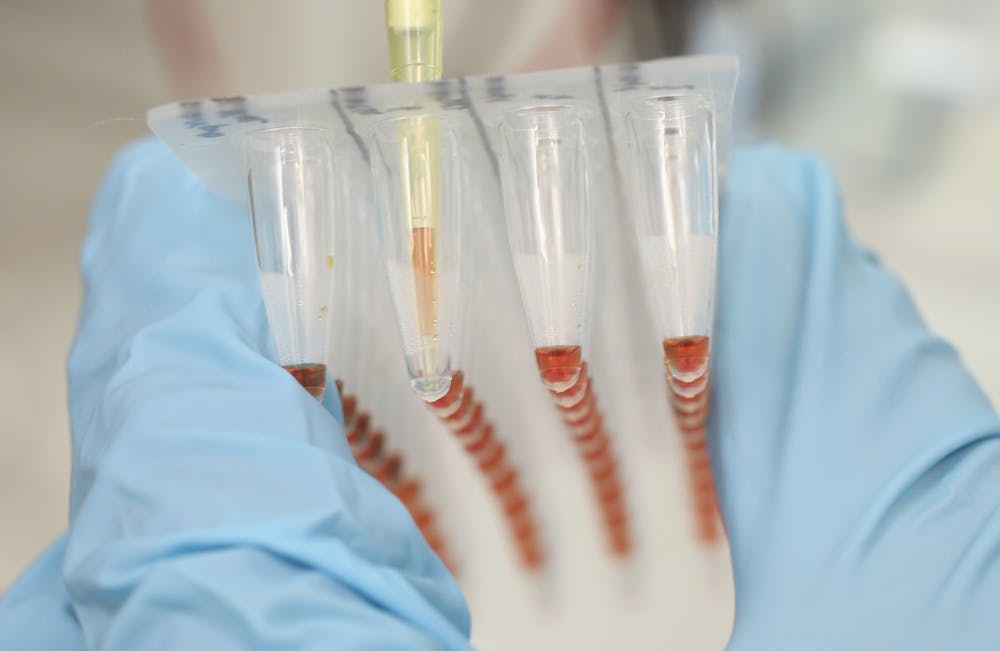 Researchers inserted engineered DNA into plant leaves to produce antibodies to fight the Ebola virus. Sean Gallup/Getty Images News via Getty Images Europe
By the time Ebola again emerged from the rainforest, this time in 2018 in the Democratic Republic of Congo, the science was ready. In November 2018, doctors launched three parallel trials comparing three different antibody cocktails. Nine months later, spectacular results allowed for an immediate end of the experimental trials so the cocktails could be used in the field.
While ZMapp did not work as well as anticipated, the trials identified two other antibody-based therapies from two different companies that did suppress Ebola symptoms in infected patients. The earlier in their infection that patients received therapy, the better the protection.
Infectious disease experts around the globe heralded the results as a vital breakthrough.
At that time last fall, it would have been difficult to imagine that within six months there’d be an even greater need for the powerful strategy of passive immunization.
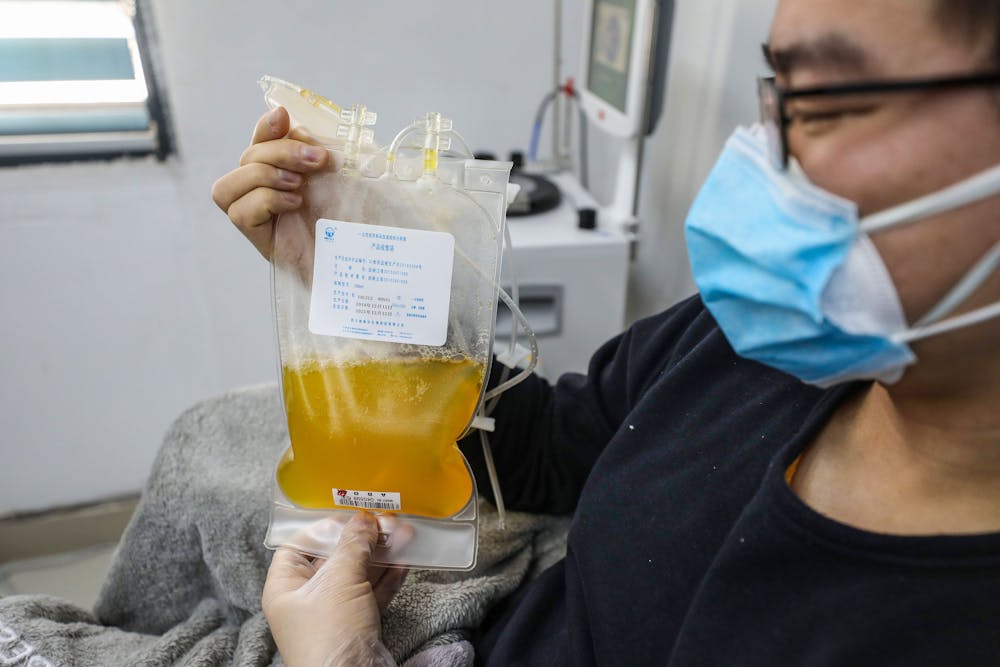 A doctor who has recovered from COVID-19 holds up a bag of his own donated plasma in Wuhan, China. STR/AFP via Getty Images
While the SARS-CoV-2 virus is moving quickly, with almost 1 million confirmed infections worldwide as of this writing, the science is racing to catch up.
Days ago a report published by scientists working in Shenzhen, China, suggested that plasma – which contains antibodies – from survivors of COVID-19 was successful in treating five critically ill patients. At the end of March, the FDA approved the use of convalescent plasma in treating severely ill people here in the U.S. In addition, Mt. Sinai in New York has established a collaboration with the FDA and other hospitals to begin clinical trials to scientifically determine whether this strategy of passive immunization is viable.
While the rapid move to evaluate this novel treatment is a moment for celebration, the science must keep moving. Convalescent plasma, which is isolated from recently recovered survivors, is in too short of a supply to be broadly useful. The most potent neutralizing antibodies must be quickly characterized and then produced efficiently in large quantities. Several companies, as well as a number of powerhouse academic labs, aim to meet the challenge of identifying and generating these life-saving NAbs.
At the fore is Regeneron, the pharmaceutical company that designed the effective Ebola treatment. Although targeting a different virus, their overall strategy remains the same. They’ve isolated and characterized NAbs and plan to engineer a cocktail of the most potent molecules. The viral target of these antibodies is the SARS-CoV-2 spike protein; the NAbs work by preventing the virus from entering cells.
Clinical trials are planned for early summer, essentially three months’ time. It is a breakneck pace for the development of such a sophisticated tool of intervention.
As the U.S. enters the exponential phase of COVID-19’s spread, this treatment cannot come soon enough.
[You need to understand the coronavirus pandemic, and we can help. Read our newsletter.]<!-- Below is The Conversation's page counter tag. Please DO NOT REMOVE. --> <!-- End of code. If you don't see any code above, please get new code from the Advanced tab after you click the republish button. The page counter does not collect any personal data. More info: https://theconversation.com/republishing-guidelines -->
Ann Sheehy, Professor of Biology, College of the Holy Cross
This article is republished from The Conversation under a Creative Commons license. Read the original article.
In The News
>WEATHER: Mark Rosenthal's 7-day forecast (:34). High of 70 today in Worcester
-Mass. could see warmer, wetter winter, National Weather Service says
>TOP OF THE NEWS
+Noon: How Worcester residents can sign up for 2027 health plans
+Noon: Gov. Healey sets 60% school breakfast goal; Worcester schools averaged 37.6%
+Noon: Early voting update: Nearly 10,000 ballots cast so far in Worcester
+Noon: Worcester man's Halloween display raises money for charity (2:57)
-Asbestos discovery closes Worcester Head Start facility
-Kelley Square and Mill Street were redesigned. Are they safer today?
-Worcester Human Rights Commission to review police policies, homeless encampment proposal
-Where is Aaron Pennington? Fugitive search enters third year (2:22)
-Max German of Shrewsbury a finalist in "Voice of Logan" contest
-Westborough police chief on leave following an incident in Shrewsbury (:20). Article
-Parents recall Uxbridge Officer LaPorta as community honors him
-Earlier: D.A.: Investigation into death of Uxbridge officer results in no charges
-Worcester County Wonders: The Phantom of the Palladium
-In historic company: Women of Worcester's past, present honored in new mural
-College closures derail students’ plans, leaving some unsure when they’ll return
>DINING OUT: Avvio Ristorante wins early buzz with home-made pasta and tasty pizzas
-Large audience, low price: Give your restaurant's social media a boost on The 016
-Phantom Gourmet visits Worcester restaurant (5:02)
-ICYMI: Anna Maria weighs giving interested buyers more time after auction cancellation
-Worcester Homeowner Summit set for November 7th at DCU Center
-Worcester police, D.E.A. find fentanyl in Clover Street raid
-Worcester police seize 38 guns, ghost gun frames
-See the rest of the day's Worcester news
>HOLDEN: This week's road closures and traffic delays
-Wachusett Teacher Spotlight: Brian Lux
>THE BURBS (brought to you by North End Motor Sales): Community Advocate Hometown Helper: Bernice Gero, animal advocate
-Warrant issued for man who broke into ex-girlfriend’s home in Barre while she was asleep
-Coolidge Elementary School's hidden staircase evokes Shrewsbury memories from decades past
-Meadows Montessori excited to open in Westborough
-New warehouse plans before Westborough Planning Board
-New Northborough fire chief says he has felt "truly welcomed" by town officials, community
>BARS & BANDS: The Mayor's Live Music List for Monday
>SHOWTIME: Gateway Players in Southbridge to hold auditions for "The Lifespan of a Fact"
-Dudley's first poetry slam brings community to the Fun Zone Playground wooded stage
-100 FM The Pike (20:41): Ken Casey from Dropkick Murphys on music as a force for change
>OPINION: Tommy Dorfman: Ticket prices are out of control. Gov. Healey’s bill will make them worse
-WCCA-TV's Chandler Chat No. 510 (28:21): City clerks & state election
-Radio Worcester's The Rundown reacts to W.P.D. internal investigation in Toomey case (24:59)
>OBITUARIES: Tribute to Worcester native who was a lauded poet
>SPORTS: NESN and NESN+ to broadcast select Holy Cross contests
-Railers lose to Maine, 3-1
-Radio Worcester (15:13): Worcester Railers celebrate 1,000 wins for city hockey
>NATIONAL: Christa Pike's executioners given ominous warning before botched lethal injection: court docs
-Devastated mom recalls horror of toddler being pronounced dead, before he's discovered alive in morgue
-Tragic: Nurse dies after shrimp allergy during honeymoon
>NEW ENGLAND: Sandra Birchmore's therapist back on the stand Monday (:59)
-Woman charged with manslaughter in 4-year-old daughter's fentanyl death (:22)
-Over 130 residents evacuated from Lexington nursing home (2:25)
>POLITICS: What does the Governor's Council do? Worcester candidates weigh in
-What is Mass. ballot Question 7? (8:52)
-Full debate on Mass. ballot Question 7 (29:03)
>COLLEGES: Clark campus conversation, McGovern visit examine America’s past and present
>TRAVEL (brought to you by Fuller RV & Rental): Airbnb making changes to guest cleaning requirements (1:39)
>BUSINESS: Central Mass. business by the numbers
-U.S credit card debt is on the rise. Here's how to keep yourself out of credit card debt
-Small businesses need to leverage home field advantage with S.E.O.
>SHOPPING: How inflation is hitting all parts of Halloween celebration (1:59)
>HOMES: The surprising places to never charge your phone, safety experts say
>HEALTH: "Circadian" depression may be the reason why you can't sleep
-How walking regularly can protect your brain for years to come (6:18)
>FOOD: Ina Garten reveals unique ingredient she uses in eggs
>TV/STREAMING: Trailer for "Lupin: Part 4" on Netflix (2:30)
>MOVIES: The craziest horror villains compilation (42:09)
>CELEBRITY: "Office Space" star Richard Riehle dies at 78
-Kurt Cobain's death investigation takes new turn over cop's shocking claim casting doubt on suicide
>ANIMALS: Hound gets caught breaking all her friends out of daycare (1:54)
>HISTORY: The Old Yarmouth Inn on the Cape is still going strong after 330 years
>GOOD NEWS: Veteran sees brother face-to-face for first time in 40 years
-Meanwhile, in England, escaped emu wins wrestling match in middle of road
Latest obituaries | | Sunday's Highlights | | Today's horoscope | | Local Sports
Classifieds
>HELP WANTED
+Servers, West Boylston restaurant
-Prep cook and waitstaff, Shrewsbury Street bistro
-Full-time police officer, West Boylston Police Department
-Bartenders, Worcester Restaurant Group
See all Help Wanteds | | Job opening? Post it here for FREE today
Quick Links: Personalize your news | | Browse members | | Advertise | | Blogs | | Invite friends | | Videos
Animals | | Boston Sports | | Business | | Cars | | Celebrity | | Colleges | | Commute & Travel | | Crime | | Faith | | Food | | Good News | | Health | | Help Wanted | History | | Homes | | Local Sports | | Lottery | | Movies | | National | | New England | | Politics | | Shopping & Deals | | SHOWTIME! | | TV & Streaming | | Weather

