
Make the016.com a preferred choice with Google by clicking here 
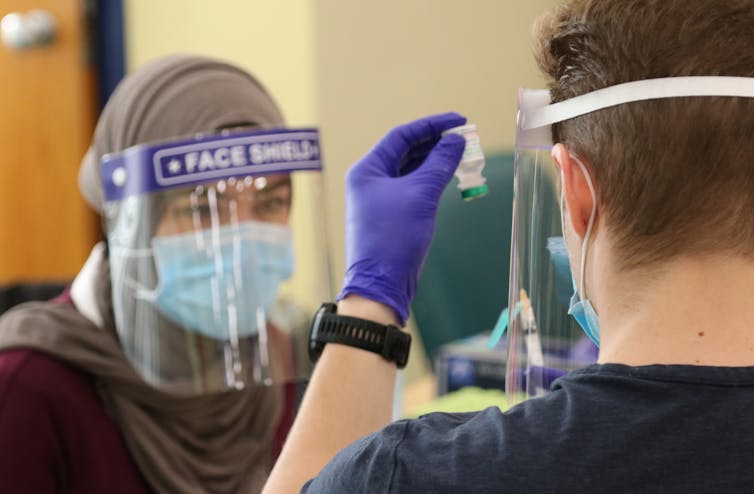
Medical students’ backgrounds often reflect the diversity of local communities, which can allow them more access and trust for vaccination efforts. Bryan Goodchild/UMass Medical School, CC BY-ND
Michael F. Collins, University of Massachusetts Medical School
The U.S. faces one of the most consequential public health campaigns in history right now: to vaccinate the population against COVID-19 and, especially, to get shots into the arms of people who cannot easily navigate getting vaccinated on their own.
Time is of the essence. As new, potentially more dangerous variants of this coronavirus spread to new regions, widespread vaccination is one of the most powerful and effective ways to slow, if not stop, the virus’s spread.
Mobilizing large “vaccine corps” could help to meet this urgent need.
We’re testing that concept right now at the University of Massachusetts Medical School, where I am the chancellor. So far, 500 of our students and hundreds of community members have volunteered for vaccine corps roles. Our graduate nursing and medical students, under the direction of local public health leaders, have already been vaccinating first responders and vulnerable populations, demonstrating that a vaccine corps can be a force multiplier for resource-strained departments of public health.
On Feb. 16, we will help to launch a large-scale vaccination site in Worcester, where as many as 2,000 people could be inoculated per day.
Importantly, a large vaccination corps that includes local medical and public health students could help reach residents who might be missed by public campaigns and hospital outreach efforts. Students often represent their region’s races, ethnicities and backgrounds, which can make it easier for them to connect with communities that are hard to reach and might not trust vaccination.
The problem of getting people vaccinated quickly isn’t just about supply – it’s also about having enough people to carry out vaccinations, particularly in hard-to-reach communities.
If quickly mobilized on a large scale, a vaccine corps could directly meet three important challenges: accelerating the nationwide rollout of COVID-19 vaccines, ensuring that doses are distributed equitably to all and delivering on the promise that all Americans are able to benefit from major medical and public health advances.
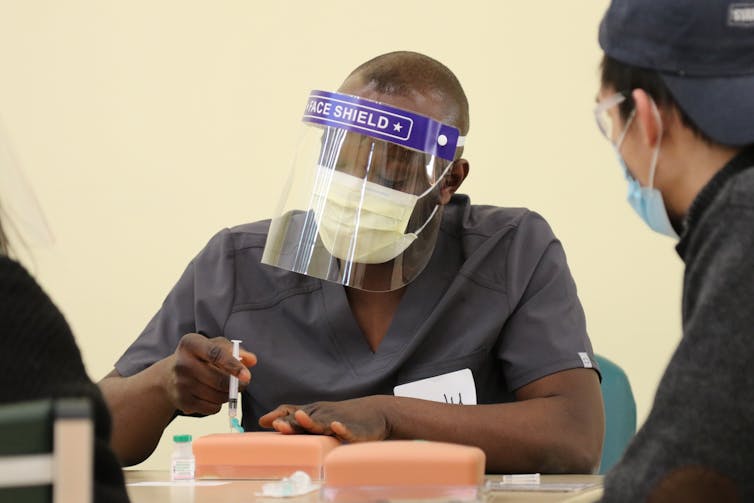
Medical students practice vaccination methods at the University of Massachusetts Medical School. Bryan Goodchild/UMass Medical School, CC BY-ND
Medical, nursing, pharmacy and other health students, as well as retired or unemployed clinicians, could deliver shots, monitor people who were just vaccinated or schedule the second doses that are required for the Pfizer and Moderna vaccines to be fully effective.
In particular, a large, well-organized vaccine corps could play a crucial role in reaching out to communities that are underserved, overlooked or hard to reach.
Corps members could staff phone banks to help people who lack internet or struggle to use online scheduling systems find vaccines in their areas and make appointments.
Our students in the vaccine corps have already helped administer vaccines in public housing complexes and homeless and domestic violence shelters. They could also provide transportation to vaccination sites or take doses directly to homebound elders who cannot safely venture out. In Alaska, for example, vaccine providers have been going out by plane and sled to remote villages to reach thousands of residents.
Members of a vaccination corps who share race or ethnicity with the community can also have an impact on overcoming people’s concerns about getting the vaccine. That’s important.
A poll released Feb. 10, conducted by the Associated Press and NORC Center for Public Affairs Research, found that only 57% of Black U.S. residents said they would definitely or probably get the COVID-19 vaccine, compared to 65% of Americans who identified as Hispanic and 68% as white. Fewer than half of Black Americans surveyed in a separate Kaiser Family Foundation poll in late January believed the needs of Black people were being taken into account.
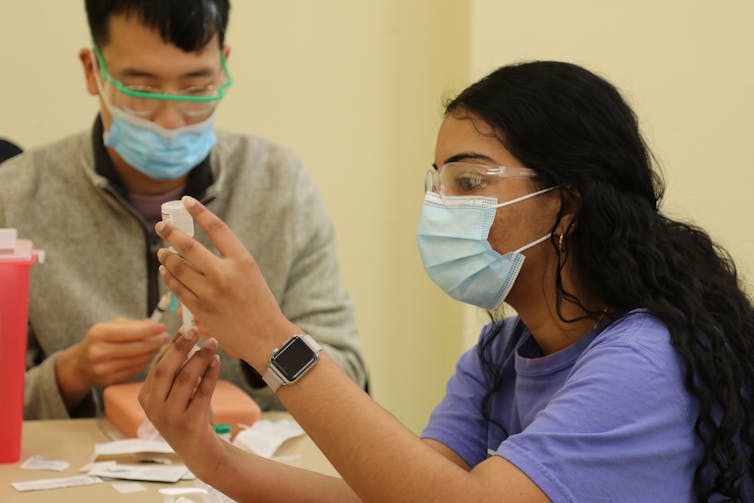 At the University of Massachusetts Medical School, 500 students have volunteered to participate in a vaccination corps. Their first project was vaccinating first responders. Bryan Goodchild/UMass Medical School, CC BY-ND
Rural areas face similar concerns, as well as the geographical challenges of reaching people in remote areas. The Kaiser Family Foundation has found that people who live in rural areas are “among the most vaccine hesitant groups.” In mid-January, it found that 29% of rural Americans surveyed either definitely did not want to get the vaccine or said they would do so only if required.
If we extrapolate these vaccine hesitancy survey results, suggesting that as many as three or four out of every 10 Americans may avoid inoculation, public health officials’ hopes of reaching herd immunity will be in jeopardy.
The U.S. has a long history of creating health corps. After the Sept. 11 attacks, the federal government launched the volunteer Medical Reserve Corps to mobilize current and former medical professionals and others with needed health skills during emergencies. Several Medical Reserve Corps units around the country are now assisting vaccination efforts.
This concept could be expanded, including by partnering with universities, to have wider, game-changing reach. The model of service our students are testing opens up many possibilities, limited only by a lack of will and imagination.
[You need to understand the coronavirus pandemic, and we can help. Read The Conversation’s newsletter.]
Michael F. Collins, Chancellor and Professor of Population & Quantitative Health Sciences and Medicine, University of Massachusetts Medical School
This article is republished from The Conversation under a Creative Commons license. Read the original article.
In The News
>WEATHER: Mark Rosenthal's 7-day forecast (:34). High of 70 today in Worcester
-Mass. could see warmer, wetter winter, National Weather Service says
>TOP OF THE NEWS
+Noon: How Worcester residents can sign up for 2027 health plans
+Noon: Gov. Healey sets 60% school breakfast goal; Worcester schools averaged 37.6%
+Noon: Early voting update: Nearly 10,000 ballots cast so far in Worcester
+Noon: Worcester man's Halloween display raises money for charity (2:57)
-Asbestos discovery closes Worcester Head Start facility
-Kelley Square and Mill Street were redesigned. Are they safer today?
-Worcester Human Rights Commission to review police policies, homeless encampment proposal
-Where is Aaron Pennington? Fugitive search enters third year (2:22)
-Max German of Shrewsbury a finalist in "Voice of Logan" contest
-Westborough police chief on leave following an incident in Shrewsbury (:20). Article
-Parents recall Uxbridge Officer LaPorta as community honors him
-Earlier: D.A.: Investigation into death of Uxbridge officer results in no charges
-Worcester County Wonders: The Phantom of the Palladium
-In historic company: Women of Worcester's past, present honored in new mural
-College closures derail students’ plans, leaving some unsure when they’ll return
>DINING OUT: Avvio Ristorante wins early buzz with home-made pasta and tasty pizzas
-Large audience, low price: Give your restaurant's social media a boost on The 016
-Phantom Gourmet visits Worcester restaurant (5:02)
-ICYMI: Anna Maria weighs giving interested buyers more time after auction cancellation
-Worcester Homeowner Summit set for November 7th at DCU Center
-Worcester police, D.E.A. find fentanyl in Clover Street raid
-Worcester police seize 38 guns, ghost gun frames
-See the rest of the day's Worcester news
>HOLDEN: This week's road closures and traffic delays
-Wachusett Teacher Spotlight: Brian Lux
>THE BURBS (brought to you by North End Motor Sales): Community Advocate Hometown Helper: Bernice Gero, animal advocate
-Warrant issued for man who broke into ex-girlfriend’s home in Barre while she was asleep
-Coolidge Elementary School's hidden staircase evokes Shrewsbury memories from decades past
-Meadows Montessori excited to open in Westborough
-New warehouse plans before Westborough Planning Board
-New Northborough fire chief says he has felt "truly welcomed" by town officials, community
>BARS & BANDS: The Mayor's Live Music List for Monday
>SHOWTIME: Gateway Players in Southbridge to hold auditions for "The Lifespan of a Fact"
-Dudley's first poetry slam brings community to the Fun Zone Playground wooded stage
-100 FM The Pike (20:41): Ken Casey from Dropkick Murphys on music as a force for change
>OPINION: Tommy Dorfman: Ticket prices are out of control. Gov. Healey’s bill will make them worse
-WCCA-TV's Chandler Chat No. 510 (28:21): City clerks & state election
-Radio Worcester's The Rundown reacts to W.P.D. internal investigation in Toomey case (24:59)
>OBITUARIES: Tribute to Worcester native who was a lauded poet
>SPORTS: NESN and NESN+ to broadcast select Holy Cross contests
-Railers lose to Maine, 3-1
-Radio Worcester (15:13): Worcester Railers celebrate 1,000 wins for city hockey
>NATIONAL: Christa Pike's executioners given ominous warning before botched lethal injection: court docs
-Devastated mom recalls horror of toddler being pronounced dead, before he's discovered alive in morgue
-Tragic: Nurse dies after shrimp allergy during honeymoon
>NEW ENGLAND: Sandra Birchmore's therapist back on the stand Monday (:59)
-Woman charged with manslaughter in 4-year-old daughter's fentanyl death (:22)
-Over 130 residents evacuated from Lexington nursing home (2:25)
>POLITICS: What does the Governor's Council do? Worcester candidates weigh in
-What is Mass. ballot Question 7? (8:52)
-Full debate on Mass. ballot Question 7 (29:03)
>COLLEGES: Clark campus conversation, McGovern visit examine America’s past and present
>TRAVEL (brought to you by Fuller RV & Rental): Airbnb making changes to guest cleaning requirements (1:39)
>BUSINESS: Central Mass. business by the numbers
-U.S credit card debt is on the rise. Here's how to keep yourself out of credit card debt
-Small businesses need to leverage home field advantage with S.E.O.
>SHOPPING: How inflation is hitting all parts of Halloween celebration (1:59)
>HOMES: The surprising places to never charge your phone, safety experts say
>HEALTH: "Circadian" depression may be the reason why you can't sleep
-How walking regularly can protect your brain for years to come (6:18)
>FOOD: Ina Garten reveals unique ingredient she uses in eggs
>TV/STREAMING: Trailer for "Lupin: Part 4" on Netflix (2:30)
>MOVIES: The craziest horror villains compilation (42:09)
>CELEBRITY: "Office Space" star Richard Riehle dies at 78
-Kurt Cobain's death investigation takes new turn over cop's shocking claim casting doubt on suicide
>ANIMALS: Hound gets caught breaking all her friends out of daycare (1:54)
>HISTORY: The Old Yarmouth Inn on the Cape is still going strong after 330 years
>GOOD NEWS: Veteran sees brother face-to-face for first time in 40 years
-Meanwhile, in England, escaped emu wins wrestling match in middle of road
Latest obituaries | | Sunday's Highlights | | Today's horoscope | | Local Sports
Classifieds
>HELP WANTED
+Servers, West Boylston restaurant
-Prep cook and waitstaff, Shrewsbury Street bistro
-Full-time police officer, West Boylston Police Department
-Bartenders, Worcester Restaurant Group
See all Help Wanteds | | Job opening? Post it here for FREE today
Quick Links: Personalize your news | | Browse members | | Advertise | | Blogs | | Invite friends | | Videos
Animals | | Boston Sports | | Business | | Cars | | Celebrity | | Colleges | | Commute & Travel | | Crime | | Faith | | Food | | Good News | | Health | | Help Wanted | History | | Homes | | Local Sports | | Lottery | | Movies | | National | | New England | | Politics | | Shopping & Deals | | SHOWTIME! | | TV & Streaming | | Weather

